
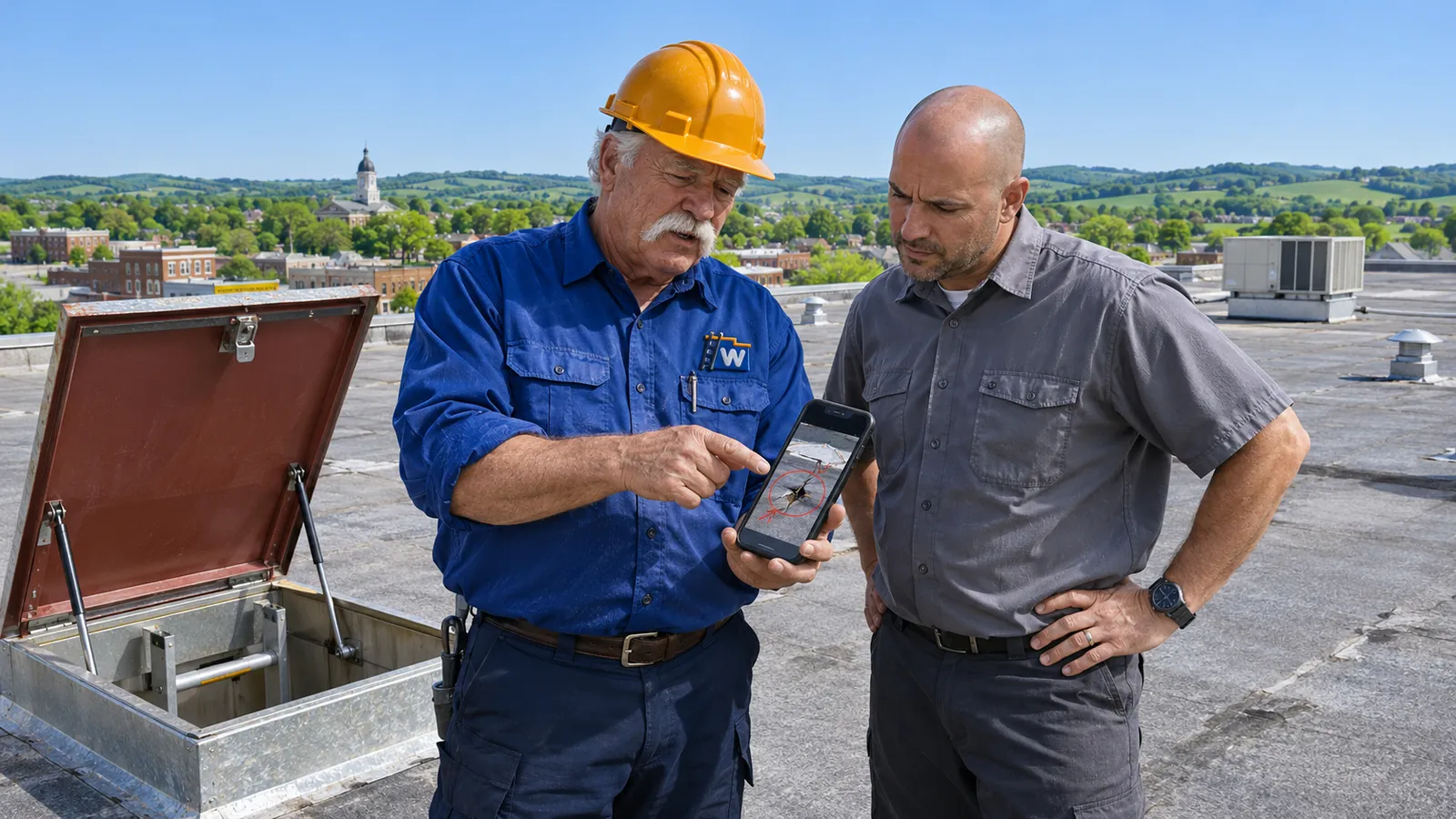
Commercial Roof Repair Questions in Winchester
Answers on Seams, Screws, Drains, Permits, and Storm Damage
These commercial roof repair questions in Winchester come from owners and facility managers, with answers on flat, metal, leak, and industrial repairs.
Commercial roof repair questions in Winchester come up in a few groups, so jump to the one that fits your roof.
Commercial roof repair is fixing the open seams, damaged flashing and worn metal panels that let water into business, industrial and farm buildings. Winchester Commercial Roof Repair handles flat roof, metal roof, leak and industrial roof repairs across Winchester and Clark County, Kentucky, plus surrounding towns including Mount Sterling, Carlisle and Owingsville.
Common Commercial Roof Repair Questions in Winchester
What counts as a commercial roof repair?
Any fix that returns a damaged part of a commercial roof to watertight condition, without replacing the whole system, counts as a repair.
Repair crews handle jobs like these.
- Resealing an open seam on a TPO or EPDM membrane.
- Patching a puncture left by a dropped tool or hail.
- Reflashing a curb under a rooftop unit.
- Replacing backed-out screws and worn washers on metal panels.
- Clearing and resetting a clogged roof drain.
- Swapping a rusted panel or a cracked skylight panel.
Small repairs done early keep water out of the insulation, which is often what turns a simple patch into a much bigger job later.
When should a roof be repaired, restored or replaced?
How far damage has spread across the roof decides the path, with isolated problems going to repair and widespread failure going to replacement.
| Path | Roof condition | Typical work |
|---|---|---|
| Repair | A few leaks, isolated seam or flashing failures | Patches, reflashing, fastener swaps |
| Restore | Aging surface, many small defects, dry insulation | Repairs plus a full coating over the field |
| Replace | Wet insulation across large areas, rusted deck | New roof system down to the deck |
A moisture scan shows where the insulation has soaked through. Roofs with wet areas under a small share of the surface can have those sections cut out and repaired first.
What separates a temporary roof repair from a permanent one?
Temporary repairs stop water for now with quick materials, while permanent repairs rebuild the damaged spot with materials matched to the roof system.
| Factor | Temporary repair | Permanent repair |
|---|---|---|
| Purpose | Stop active water during bad weather | Restore the roof detail for the long term |
| Materials | Roof cement, repair tape, tarp | Matching membrane, flashing or metal panel |
| Surface prep | Minimal | Cleaned, primed, dried |
| Follow-up | Must be redone | Checked at routine inspections |
Asphalt roof cement smeared on a TPO or EPDM sheet can make the permanent fix harder later, since the residue has to be cleaned off before a compatible patch will bond.
Which types of commercial roofs can be repaired?
Nearly every commercial roof type can be repaired as long as the damage is limited and the material underneath still holds a patch.
Common systems on central Kentucky buildings include these.
- TPO and PVC membranes, repaired with heat-welded patches.
- EPDM rubber, patched with primer and cover tape.
- Modified bitumen, fixed with new cap sheet and torch or cold adhesive.
- Built-up roofs with gravel, repaired in plies after the stone is cleared.
- Metal panels, fixed with new fasteners, sealant, lap work or panel swaps.
Identifying the system comes first, because each one needs compatible materials at the patch.
Flat Roof Repair Questions
Can an open seam on a flat roof be repaired?
Yes, an open seam on a flat membrane roof can be repaired by cleaning the lap, drying it and rebonding it with the method the membrane was built for.
On TPO and PVC, the lap gets cleaned with membrane cleaner and rewelded with hot air, often with a cover strip over the repair. On EPDM, the old adhesive is scrubbed off, the lap is primed, and new seam tape goes in with a cover patch at each end.
Seams that open across many rolls at once usually point to aging adhesive or poor original welds, and a full roof check makes sense before patching one at a time.
What should be done about blisters on a flat roof?
Blisters form where moisture or trapped air pushes the roofing layers apart, and small dry blisters are often left alone and watched while large or broken ones get cut out and patched.
Repair follows a set order.
- Cut the blister open in an X pattern.
- Dry the area and check the insulation underneath.
- Fold the flaps back down and bond them.
- Cover the area with a new ply or membrane patch.
Blisters show up most on built-up and modified bitumen roofs. Clusters of them across the field point to wet insulation, which a moisture scan can confirm.
How is ponding water on a flat roof fixed?
Ponding gets fixed by finding why water stays put, then clearing the drain, adding slope or adding a drain where the low spot sits.
Causes and fixes line up like this.
| Cause | Repair |
|---|---|
| Clogged drain strainer | Clean the bowl and reset the strainer |
| Sagging deck between joists | Structural check, then tapered fill |
| Crushed insulation | Replace boards under the low area |
| Missing cricket behind a curb | Add a tapered cricket |
| Drain set too high | Lower the drain or add a sump |
Water standing for days on a flat roof breaks down seams and coatings faster, and its weight adds strain to the deck.
How is a puncture in a membrane roof patched?
Membrane punctures get patched with a piece of matching material that extends past the hole on every side, bonding it with the same method used for the seams.
Before patching, crews check whether water has entered through the hole. A soft spot around a puncture usually means wet insulation that needs to be cut out and replaced.
On TPO and PVC, the patch is rounded at the corners and welded with hot air. On EPDM, a primed cover patch with rounded corners is rolled on. Common causes include dropped screws, HVAC panels set down on the roof and hail.
How many patches can a flat roof take before repair stops making sense?
Repair stops making sense when patches start covering a large share of the roof or new leaks keep appearing between old repairs.
Several signs point toward a bigger plan.
- Patches cluster around the same drains, curbs or seams.
- Leaks return after each storm in new locations.
- Moisture scans show wet insulation spreading.
- Failures show up along many seams instead of one or two.
A roof with dry insulation and a worn surface can sometimes be restored with a coating after repairs. Widespread wet insulation means replacement, since patches over soaked boards keep failing.
Commercial Metal Roof Repair Questions
How are leaking screws on a metal roof repaired?
Leaking metal roof screws get backed out and replaced with fresh fasteners that have new washers, often one size larger when the old hole has stripped.
Screw leaks come from two sources. Rubber washers harden and crack after years in the sun, and daily expansion of the panels slowly works screws loose from the purlins.
Repair crews go row by row along each purlin line. Loose screws get tightened, missing ones get added and stripped holes take an oversized screw. Fastener lines near the eaves and ridge usually need the most work.
How are leaking end laps on metal panels repaired?
End laps that leak get fixed by opening or cleaning the overlap, adding new butyl tape or sealant between the panels and restitching the lap with fresh fasteners.
Water gets drawn uphill into end laps by wind and capillary action, especially on low-slope metal roofs with long panel runs.
When the lap itself has rusted, crews clean it to firm metal and treat it. Laps with rust-through at the lower panel edge can need a short panel section replaced. After the next heavy rain, a look at the ceiling under the lap confirms the repair is holding.
Can a rusted metal roof panel be patched?
Rusted panels with surface rust can be cleaned and treated, while panels with holes get a patch plate or a full panel swap depending on how much steel is gone.
| Rust condition | Repair |
|---|---|
| Surface rust on firm steel | Wire brush, rust primer, finish paint |
| Pitting along laps | Clean, prime, seal and reinforce |
| Small holes | Patch plate with sealant and fasteners |
| Large rusted areas | Replace the panel |
Panel swaps on R-panel roofs work by removing the fasteners on the damaged sheet and sliding a new one under the upslope panel. Matching profile and gauge matters so laps line up.
How are metal roof gutters and valleys repaired?
Gutters and valleys on metal roofs get repaired by clearing debris, sealing open seams and joints and replacing sections that have rusted through.
Built-in gutters, which sit inside the roof line, cause the most trouble, since a leak there drips straight into the building. Hung gutters at the eaves leak mostly at end caps, joints and downspout outlets.
Valleys collect leaves and grit that hold moisture against the steel. Repair crews clean the valley, check the panel edges along it and reseal or replace the valley flashing. Overflowing gutters also push water under eave trim, so downspout capacity gets checked during the visit.
How do metal roof repairs differ from membrane roof repairs?
Metal roof repairs center on fasteners, laps and rust, while membrane repairs center on seams, punctures and flashings, and the tools and materials differ for each.
| Issue | Metal roof repair | Membrane roof repair |
|---|---|---|
| Main leak points | Screws, end laps, ridge caps | Seams, curbs, drains |
| Patching | Patch plate or panel swap | Matching membrane patch |
| Sealing | Butyl tape and sealant | Welding or seam tape |
| Surface damage | Rust treatment | Blister and puncture repair |
| Movement issue | Fastener back-out | Seam stress at corners |
Buildings that combine both systems need crews comfortable with each, especially where a metal roof meets a flat section along a wall.
Commercial Roof Leak Repair Questions
How do roofers trace a commercial roof leak to its source?
Leak tracing starts with the stain inside and works upward, matching the interior spot to roof details above it, then following the path water could take along the deck.
Crews check these points first.
- Curbs and flashings near the stain.
- Seams and laps upslope of the spot.
- Drains, scuppers and gutters that might back up.
- Pipe boots, pitch pans and skylight frames.
When the source stays hidden, crews can flood-test a section with a hose or use moisture meters and infrared scans. Notes from the building staff on which storms cause the leak help narrow the search.
Where do leaks usually start on each type of commercial roof?
Leaks start at different details on each roof type, because each system has its own weak spots.
| Roof type | Common leak sources |
|---|---|
| TPO or PVC | Seam welds, corners, pipe boots |
| EPDM | Seam adhesive, flashing at curbs, punctures |
| Modified bitumen | Blisters, cap sheet laps, base flashing |
| Built-up gravel | Pitch pans, cracked plies, gravel stops |
| Metal R-panel | Screws, end laps, ridge caps |
| Standing seam | Seam terminations, pipe boots, trim |
Flashing at walls and curbs is a common leak point on every system, since it is where the roof meets something that moves differently.
Why does a leak show up far from the actual hole in the roof?
Water entering a roof often travels sideways along the deck flutes, insulation joints or purlins before it drips, so the ceiling stain can sit many feet from the opening.
On steel decks, water runs along the flutes until it finds a seam or fastener hole. On metal buildings, it follows the purlin down to a low point.
Wet insulation also holds water and releases it slowly, which is why leaks sometimes appear days after rain. Tracing upslope and along the deck pattern from the stain is how crews close in on the actual source.
How are leaks around rooftop units and curbs repaired?
Leaks around rooftop units get repaired by resealing or rebuilding the curb flashing, fixing the cap and counterflashing and adding a cricket where water piles up on the uphill side.
Units also leak through their own housings. Loose access panels, failed gaskets and condensate lines that drain onto the roof can all look like roof leaks.
Crews check the curb height, since curbs that sit low in the insulation leave too little room for flashing. Pitch pans around pipes and supports near the unit get checked too, because their filler shrinks and cracks over time.
What should a building owner do while waiting for a leak repair?
Protect the inside of the building first by moving stock and equipment out of the drip zone, setting buckets and marking the spot so it can be traced later.
Steps that help the repair visit go faster include these.
- Photograph the stain and note the date and weather.
- Clear roof drains and gutters from the ground if safely reachable.
- Shut off power to any fixture under the leak.
- Write down which storms or wind directions make it worse.
Stay off the roof during storms or high wind. Wet membrane and metal panels are slick, and edges are hard to see in rain.
Industrial Roof Repair Questions
How are repairs handled on a roof over an operating plant?
Repairs over operating plants get scheduled around shifts and shutdowns, with crews working in small sections and keeping each area watertight when each work day ends.
Before the crew goes up, the plant and the roofers agree on a few items.
- Lockout of rooftop units that need to be moved or reflashed.
- Hot work permits when welders or torches are used.
- Barricades on the floor wherever deck sections get cut out.
- Access routes that avoid loading docks and forklift traffic.
Deck sections that have rusted from long-term leaks get cut out and replaced from above, with the floor area underneath closed off during that work.
How do exhaust fans and process vents damage a plant roof in Winchester?
Exhaust fans that discharge grease, oils or chemicals break down roofing membranes over time, leaving soft, swollen or cracked areas around the fan curb.
The repair plan depends on what the fan releases.
- Grease from kitchens calls for a grease containment box and a grease-resistant patch.
- Oil mist from machining softens EPDM and asphalt roofs quickly.
- Heat from process exhaust ages membranes around the curb.
Damaged areas get cut out and replaced with membrane rated for the exposure. A walkway path and sacrificial pad around the fan help protect the new patch.
How is hail or storm damage checked on an industrial roof?
Hail and storm damage on industrial roofs gets checked by walking the full roof, looking at the edges, rooftop equipment and membrane surface for impact marks, tears and lifted flashing.
Inspection points include these.
| Area | What to look for |
|---|---|
| Edge metal and coping | Lifted or bent sections |
| Membrane field | Cracks, bruises, punctures |
| Metal panels | Dents on ribs, split sealant |
| Skylights | Cracked or holed panels |
| Rooftop units | Bent fins, displaced curbs |
Photos taken with dates help when damage gets reported to an insurer. Core samples confirm whether hail has crushed insulation under the membrane.
How do repairs reduce foot-traffic damage on industrial roofs?
Foot-traffic damage gets reduced by repairing crushed spots and punctures, then adding walkway pads along the paths maintenance crews use most.
Industrial roofs see heavy traffic from HVAC techs, electricians and plant staff. Over time, insulation crushes under the membrane along those paths and tools left on the roof puncture the sheet.
Repairs replace crushed insulation and patch the membrane. Walkway pads made for the membrane type then go down from the roof hatch to each unit, guiding traffic to protected routes.
How are pitch pans and pipe supports repaired on industrial roofs?
Pitch pans and pipe supports get repaired by cleaning out shrunken filler, refilling the pan with fresh pourable sealer and resealing the pan to the roof.
Pitch pans surround odd-shaped penetrations like structural steel or bundled conduit. Their filler shrinks and pulls away from the penetration over time, leaving a gap water runs into.
Where possible, crews replace pitch pans with prefabricated boots or curbs, which need less upkeep. Pipe supports that dig into the membrane get new pads or roller supports so pipes can move without tearing the roof.
Question About Your Own Roof?
Call us with what you see inside and on the roof. We answer plainly and set up an inspection if it needs one.
- Inspection first
- Leak traced to source
- Plain answers
Weather, Permits and Codes in Winchester
How do freeze-thaw swings around Winchester damage commercial roofs?
Freeze-thaw cycles open small cracks wider each time water freezes in them, so seams, flashing joints and sealant around fasteners take the most damage.
Temperature swings in the area are sharp. NWS Louisville's yearly climate report for 2024 shows the Lexington station dropping to minus 7 degrees in January and then climbing into the mid-60s inside of a week.
Swings like that make metal panels expand and contract hard against their screws. Membrane seams flex at corners and around curbs. A roof walk after winter catches split sealant, opened laps and backed-out fasteners early.
When should a commercial roof be checked after a storm in Clark County?
After hail, high wind or heavy rain, check the roof as soon as conditions are safe, starting from the ground before anyone climbs up.
From the ground, look for these signs.
- Bent or missing edge metal and gutters.
- Lifted ridge caps on metal buildings.
- Debris piled near drains or downspouts.
- Water stains on interior ceilings.
On the roof, inspect skylights, rooftop units, seams and flashings. Take dated pictures of every damaged spot before anything gets cleaned up or thrown away.
Does a commercial roof repair need a permit in Kentucky?
Small commercial roof repairs often fall outside permit review, but structural work, deck replacement and large repairs can require one under the 2018 Kentucky Building Code.
The Kentucky Department of Housing, Buildings and Construction lists that code as the one currently enforced, based on the 2015 International Building Code.
Repairs that are most likely to trigger review include these.
- Replacing rusted deck or purlins.
- Raising or adding curbs for rooftop units.
- Changing drainage with new drains or scuppers.
Ask the local building office or the state before structural repair starts.
Which offices handle roof repair permits around Winchester?
Repair permits around Winchester go through the local building office in Clark County and Owingsville, while other nearby towns use the Kentucky HBC.
| Town | County | Office for structural roof repairs |
|---|---|---|
| Winchester | Clark | Winchester Building Inspections |
| Carlisle | Nicholas | State office (Kentucky HBC) |
| Camargo | Montgomery | State office (Kentucky HBC) |
| Jeffersonville | Montgomery | State office (Kentucky HBC) |
| Mount Sterling | Montgomery | State office (Kentucky HBC) |
| Owingsville | Bath | Owingsville inspector inside city limits |
Electrical work tied to roof repairs, such as moving conduit or a service mast, can follow a different path in each county.
Winchester Questions About Commercial Roof Repair Costs
What affects the cost of a commercial roof repair?
Cost for a repair rises and falls with the size and location of the damage, how much material needs replacing and how hard the roof is to reach.
Cost factors include these.
- Number of leaks and how spread out they are.
- Wet insulation that needs to be cut out.
- Deck damage found under the membrane.
- Rooftop equipment that must be moved or disconnected.
- Roof height and access for lifts or ladders.
- Matching materials for older roof systems.
A small seam repair costs far less than a repair that uncovers rusted deck. Catching leaks early keeps more repairs in the smaller range.
Can commercial roof repairs be expensed under Section 179?
Some roof spending can be expensed under Section 179, because IRS Publication 946 treats roofs on existing nonresidential buildings as qualified real property.
The 2026 limit is $2,560,000, with phase-out beginning above $4,090,000 in qualifying purchases.
Some repairs may instead be deductible as ordinary maintenance. A CPA can sort which items fall where. Keep invoices that separate patching, flashing work, panel swaps and deck replacement so each item can be reviewed.
What records help when a roof repair is tied to storm damage?
Dated photos, weather reports and a written description of the damage help when a roof repair follows a storm.
Keep these records.
- Photos of interior stains and roof damage with dates.
- The storm date and any NWS warning for the area.
- Notes on when leaks started and where.
- Invoices for temporary repairs.
- Inspection reports showing hail marks or lifted flashing.
Insurance policies vary, so check coverage terms with the insurer. Repairs that stop active leaks should go ahead, since waiting can let water damage spread into insulation and the deck.
Winchester Questions About Commercial Roof Repair by Town
Do roof repairs in Winchester need a city permit?
Roof repairs on Winchester commercial buildings go through the City of Winchester Building Inspections office when a permit is required, and that office covers both the city and all of Clark County.
Its permit rule reaches any structure of at least 200 square feet. Small patch and seam repairs usually stay outside review, but deck replacement, new curbs and structural repairs can need a permit.
Before structural work starts, call that office, give the street address and describe the repair in a sentence or two. Keep the response with the building records.
When does a Winchester roof leak repair need an electrical permit?
Winchester roof leak repairs need an electrical permit when the fix involves moving wiring, disconnecting rooftop equipment or relocating conduit.
The city's Building Inspections department issues electrical permits along with building permits. Repairs that often involve electrical work include these.
- Raising a curb under a rooftop unit to fix a leak.
- Lifting conduit that has worn through the membrane.
- Resealing a service mast that passes through the roof.
Coordinate with an electrician before the roofing crew arrives so the work happens in the right order.
Who inspects rooftop HVAC and plumbing repairs in Mount Sterling?
Montgomery County's state sheet lists an HVAC inspector, and its plumbing inspector works out of the county health department, so Mount Sterling leak repairs that touch rooftop units or vent stacks can involve those trades.
Roof leaks around equipment often need help from the HVAC side. Condensate lines, unit gaskets and curb adapters can all be part of the leak.
Vent stack boots that split get replaced by the roofing crew, but stacks that need to be moved go to a plumber. Line up those trades before the roofing repair.
Which office reviews structural roof repairs in Jeffersonville?
Structural roof repairs on Jeffersonville commercial buildings are reviewed by the Kentucky HBC. Montgomery County leaves building review to the state.
Metal buildings around Jeffersonville sometimes need purlin or framing repair after long-term leaks. Rust at the purlins under a leaking end lap can weaken the steel.
Replacing purlins, adding framing or repairing a sagging deck are the repairs most likely to need state review. Simple fastener, seam and flashing repairs typically do not. Call the state office with a written description of the repair first.
Where do Carlisle roof repairs get permitted and inspected?
Carlisle roof repairs that need a permit go through the Kentucky HBC, and the Nicholas County sheet assigns state inspectors for building, wiring, HVAC and plumbing work there.
Storm repairs on Carlisle buildings that include deck replacement or new curbs fall under that state review.
Electrical inspection follows the city or County Judge Executive depending on location. Repairs that touch rooftop units, conduit or vent stacks may bring in the state trade inspectors. Keep photos and a short repair description ready for the call.
Which office handles electrical questions for Owingsville roof repairs?
Electrical questions tied to Owingsville roof repairs go to the City of Owingsville or the Bath County Judge Executive, according to which side of the city line the building stands, per the Bath County state sheet.
That matters when a leak repair involves moving conduit, disconnecting a rooftop unit or resealing a service mast.
Electric service in Bath County comes from Clark Energy or Fleming-Mason Energy, according to East Kentucky Power Cooperative's member list. Call the provider listed on the bill before work near a service mast or meter base.
Which electric provider serves Camargo buildings for roof repair work?
Camargo buildings in Montgomery County are served by Clark Energy, according to East Kentucky Power Cooperative's member list, though owners should confirm with the name on their bill.
Roof repairs near service masts, weatherheads or meter bases on the eave wall need coordination with the utility. Leaks around a service mast boot are common on metal buildings.
Building permits for Camargo come from the Kentucky HBC, which covers all of Montgomery County.
Which other towns around Winchester get roof repair service?
Roof repair service around Winchester also covers these nearby towns.
| Town | County | Electric co-ops listed for the county |
|---|---|---|
| Clay City | Powell | Clark Energy, Jackson Energy |
| Frenchburg | Menifee | Clark Energy, Licking Valley RECC |
| Sharpsburg | Bath | Clark Energy, Fleming-Mason Energy |
| Millersburg | Bourbon | Blue Grass Energy, Clark Energy |
| North Middletown | Bourbon | Blue Grass Energy, Clark Energy |
Each town gets the same leak tracing, flat roof, metal roof and industrial repair work, from seam patches to panel swaps.
Getting Started
What details help a repair crew find a leak faster?
Notes on where and when the leak shows up help a crew find the source faster.
Useful details include these.
- Interior stain locations sketched on a floor layout.
- Which storms or wind directions cause leaks.
- Past repairs and patches on the roof.
- Roof age and system type, if known.
- Access to the roof hatch or ladder.
Photos of interior damage with dates also help match leaks to specific storms.
What happens on the first repair visit?
The first repair visit starts with an inspection of the leak area and nearby roof details, followed by repairs to the source.
Crews check seams, flashings, curbs, drains and fasteners near the leak. Moisture readings show whether insulation has gotten wet.
Small, simple fixes can be handled once the source is confirmed. Larger damage gets documented with photos and notes, and the owner hears in plain terms which areas call for repair, restoration or replacement.
Sources
- Kentucky HBC: Find Currently Enforced Code
- IRS Publication 946: How To Depreciate Property
- NWS Louisville: 2024 Annual Climate Summary
- City of Winchester: Building Inspections
- Kentucky HBC: Clark County inspector listing
- Kentucky HBC: Montgomery County inspector listing
- Kentucky HBC: Nicholas County inspector listing
- Kentucky HBC: Bath County inspector listing
- East Kentucky Power Cooperative: Owner-Member Cooperatives
Still Have Commercial Roof Repair Questions in Winchester?
Call us or ask for an estimate. We inspect the roof and answer your questions on site.